Purvi Shah: Making Room for All of Herself
Through freehand henna-inspired borders, layered canvases, and intuitive painting, Purvi Shah brings together the cultures and memories that shape her. We sat down with her to talk about finding her own artistic language, carrying her mother’s wisdom, and creating work that invites us to pause.
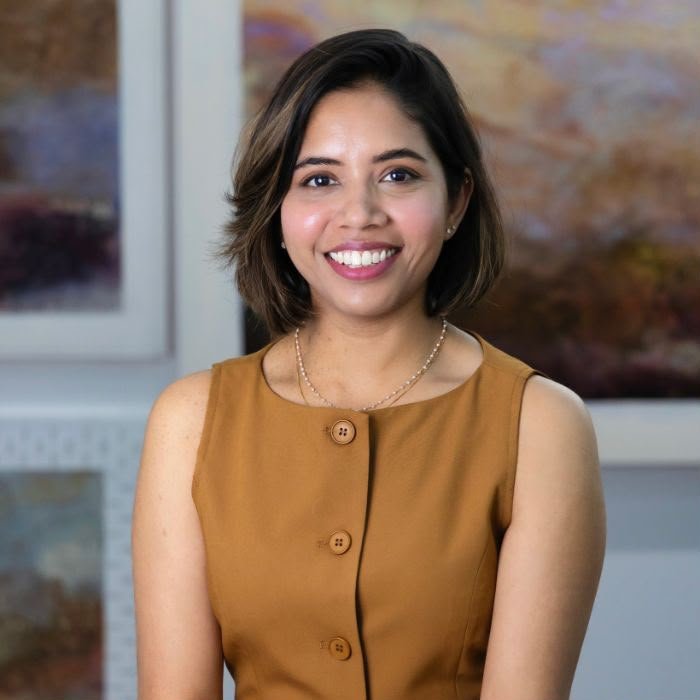
Purvi Shah: Making Room for All of Herself
The first thing we wanted to ask Purvi Shah about was the border. If you have stood in front of her work, you may understand why. The intricate, henna-inspired patterns are so carefully formed that people often assume she uses a stencil. Every detail is made freehand, without a drawing underneath. She judges the spacing by eye, building the pattern with a steadiness that asks for her full attention. When we sat down with her ahead of Affordable Art Fair Houston, we wanted to understand what happens beyond that first impression. Our conversation brought us back to childhood, family, and the experience of finding a place between cultures.
The Border and the Freedom Within It
For Purvi, creating the borders has become a kind of meditation. Each repeating detail requires focus. She has to stay present, paying attention to the spacing and the relationship between one mark and the next. The borders also hold one part of her personality: the part that loves precision, structure, and order. In the center of the painting, she gives another part of herself room to lead. There, she plays, follows her intuition, and lets the work unfold. Her current approach took shape in 2025, during a difficult period when she wanted to make work that brought her joy. She returned to the things she had loved as a child: henna, its delicate application, and the decorative borders of Indian clothing. Those familiar details offered a way forward. They also helped her make work that felt more fully her own.
Where Art First Began
Purvi’s first memory of art is watching her mother and grandmother embroider a sari. She remembers wanting to make something beautiful with her own hands. Her mother enrolled her in drawing classes, followed by watercolor and oil painting. Art was part of her childhood, even though pursuing it professionally did not feel like an available path. She stepped away from it after high school and returned once she began working, looking for a way to relax. Later, when she decided to pursue art professionally, a year of training at Milan Art Institute strengthened her skills in composition, mixed media, and painting. That foundation continues to support the freedom she allows herself in the studio.
Finding a Place Between Cultures
Born in India and raised between India and the United States, Purvi spoke about feeling too Indian in one place and too American in the other. Early in her practice, she found herself following the art she saw around her in the U.S. Eventually, she began asking what she wanted to create and how her own identity could take shape on the canvas. The henna-inspired borders became an intentional part of that answer. Contemporary painting and South Asian references could live together in the same work. She could make space for both. That exploration continues in her canvas-on-canvas pieces. Purvi described the layering as a way of understanding where she belongs, allowing different materials and surfaces to hold tension and harmony together. As she explained it, she does not need to belong to only one place. She can thrive where she is.
Giving the Work Room to Change
Purvi’s process leaves room for uncertainty. Her first diptych began with the simple desire to try working across two panels. At one stage, she disliked it. As she added oil paint over the acrylic base, her relationship with the piece changed. It became a favorite and reminded her that she could trust the skills she had spent time developing. Working with raw canvas brought its own frustrations. She was drawn to the material before she knew how to make it work with her borders. After repeated attempts, an exasperated moment of throwing paint onto the canvas led to a breakthrough. Visitors now ask about the drips, blurred edges, and visible brushstrokes that emerged from that exploration. She begins each collection on its largest canvas, where she has room to move and test ideas. From there, she carries selected colors and elements into smaller works, including her Tiny Universe series. Listening to her describe it, we could hear how much she values having space to discover something before deciding what to keep.
Her Mother’s Words, Carried Forward
Her mother’s voice remains present in the work. Purvi describes herself as ambitious, often moving straight from one goal to the next. Her mother, who passed away in 2021, used to remind her to slow down and celebrate what she had accomplished. The title Take Your Time. It’s Not a Race carries that reminder. For someone who is always thinking about what comes next, a painting can become a place to pause and acknowledge what is already here. Purvi told us that every collection includes something that connects back to her mother. It is a personal thread that continues through the work.
A Moment of Peace
When we asked what she hopes people feel in front of her paintings, her answer was peace. She wants viewers to enjoy the details and sense the care that went into making them.
“If you can stand in front of it and feel some kind of peace, my job is done.”
That care is part of what drew us to Purvi’s work. At House of Devi, we are grateful to represent an artist who is giving herself room to experiment, honor what she carries, and find her own visual language. During our conversation, she spoke about finally finding her people through House of Devi. Hearing that meant a great deal to us. We look forward to sharing her work with you. Come close, spend some time with the borders, and let your eye wander through the layers. There is a lot to discover. Explore Purvi Shah’s work alongside Ami Mehta, Jigna Patel, and Sneha Bhavsar at the House of Devi Artist Collective, Booth A4, at Affordable Art Fair Houston, October 15–18, 2026, at the George R. Brown Convention Center.
Have thoughts on this piece?
Start a conversation