Jigna Patel: A Place to Stop and Breathe
In conversation with House of Devi, Jigna Patel shares how her journey through pharmacy, motherhood, and meditation informs her textured mountain paintings—and her hope that they offer a place to pause, feel grounded, and find peace.
Jigna Patel: A Place to Stop and Breathe
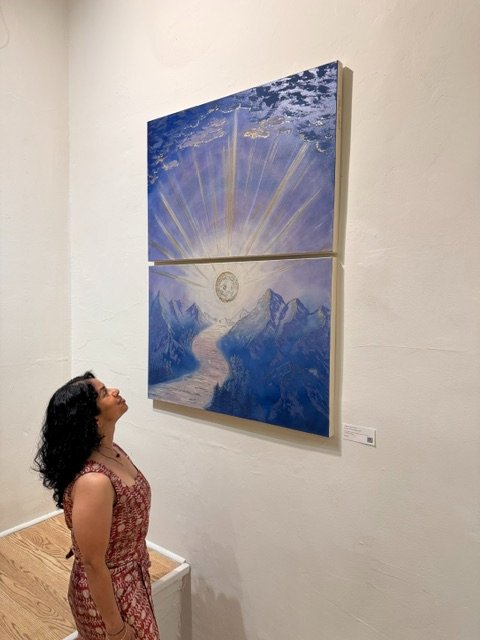
Before beginning a canvas, Jigna Patel meditates. Before adding another layer, she returns to that practice. She asks God to work through her hands. That is where our conversation with Jigna took us: into the intention behind her paintings, the life that brought her to them, and what she hopes people feel when they encounter her work. “I want it to be a place for you to stop and breathe,” she told us. We understood that feeling. Shital lives with one of Jigna’s paintings and described it as “a place to land.” Manisha spoke about the power she feels in the work, alongside an equally strong sense of safety. The mountains have a vastness to them, yet being in their presence can feel comforting. As we prepare to share Jigna’s work through House of Devi, we wanted to share the person and practice behind that experience.
Art Was Always There
When we asked Jigna about moving from pharmacy into art, she gently reframed the question. Creativity had been part of her life all along. Growing up in London, she danced and painted. During two years of intensive art and textile design coursework in high school, she explored materials, texture, fabric, and the fundamentals that still inform her practice. After moving to America, she pursued pharmacy school and residency, followed by nine years in transplant clinical pharmacy and later work in intensive care. She found her way back to painting in the evenings, after her youngest child began sleeping through the night. Her days were full, and she needed an outlet. In a spare room in her Houston home, she began experimenting with paint again. This time, she gave herself room to work more freely. Abstract painting opened up new possibilities. People began buying her work and requesting commissions, which she fitted around long workdays and a demanding commute. Then came COVID-19.
A Growing Need to Create
Working in the ICU at UTMB during the pandemic brought Jigna close to loss and uncertainty. There was little time to paint, or even to process everything happening around her. Those experiences deepened her reflection on how we live, how we face death, and how we find peace. Spirituality had helped sustain her through her work in intensive care. Through meditation, she began feeling a pull to paint what she describes as messages of peace. She wanted to create something people could bring into their homes—something that might help them pause, understand themselves, and feel connected to the divine. She loved pharmacy and took its responsibilities seriously. As her desire to paint grew, she recognized that she wanted to give her full attention to art. She stepped away from pharmacy and became a full-time artist. She also reconsidered her materials. Concerned about the health and environmental effects of working with resin, she changed mediums. The process of making the work needed to feel consistent with the peace she hoped it would offer.
Returning to the Mountains
Despite living in Houston and Chicago, Jigna keeps returning to mountains. Their valleys and peaks speak to her about struggle, strength, and the changes we continually navigate. Reaching one summit does not mean the journey is finished. There is a descent, another climb, another landscape to learn. She also feels a deep spiritual connection in the mountains. The ethereal backgrounds in her paintings reflect that experience: the feeling of being close to something greater than herself. Her mountains take shape through layers of joint compound and modeling paste. She works the material into smooth stretches of snow and rough rock formations, sometimes deliberately creating cracks to capture the character of a ridge. Before adding color, she leaves the white textured surface overnight and studies it under dim studio lighting. The shadows help her see whether the formations feel natural and where they need adjusting. That attention to light carries into the finished painting. Move around it, and different details emerge. Shital shared that she enjoys looking at her painting from different parts of the room, discovering how its appearance changes.
Making Room for Your Story
In Aspen and the Snow Mass Lake, Jigna draws on memories of a trip for her husband’s 40th birthday. She initially tried working on smaller canvases, but they could not hold the sense of scale she remembered. Eventually, she chose a 36-by-48-inch canvas. The mountain’s resemblance to an iceberg led her to think about hidden depths. Where mountain and water meet, she also sees the interconnectedness of life: trees, snow, water, land, and the living things that depend on them. These are the ideas she brings to the painting. She welcomes the viewer’s own story, too. That openness extends to Ananta, a work exploring devotion through Hanuman’s love for Ram and Jigna’s memories of her grandmother. Her grandmother taught her devotional songs and practical skills that remain part of her everyday life. Over time, Jigna came to understand more deeply the love and intention within those teachings. For her, the painting holds a belief that love continues beyond death.
Stay for a While
When we asked what she would say to someone who felt moved by a painting, Jigna wanted to begin by asking what they were feeling. Then she offered a simple invitation: “Don’t rush it. Stay here a while.” That generosity stayed with us. She gives viewers time to discover their own relationship with the work. At House of Devi, we are grateful to share Jigna’s paintings and the care behind them. When you encounter one, give yourself a moment. Look from another angle. Notice where your attention settles. You may find a place to land.
Have thoughts on this piece?
Start a conversation